
Problem Statement
A fast-growing technology company relied on a team of eight analysts to manually research market trends and competitive intelligence. The process was unscalable: each research cycle took 2–3 weeks, with analysts spending 80% of their time on manual data collection and only 20% on actual strategic analysis. To keep up with market velocity, the company needed to 5x their research output without a 5x increase in headcount.
"We were drowning in information but starving for insight. Our analysts were doing the work of web crawlers instead of strategists." — VP of Strategy, Client
Value Proposition
We developed an autonomous AI research agent that transforms the research lifecycle from a manual chore into an automated pipeline. By leveraging a multi-agent architecture, the system mimics a human research team’s workflow—discovering, filtering, and synthesizing data at a scale impossible for humans.
This solution allows analysts to shift from data gatherers to strategic editors, focusing their expertise on the final 20% of work that requires high-level human judgment.
Our Approach
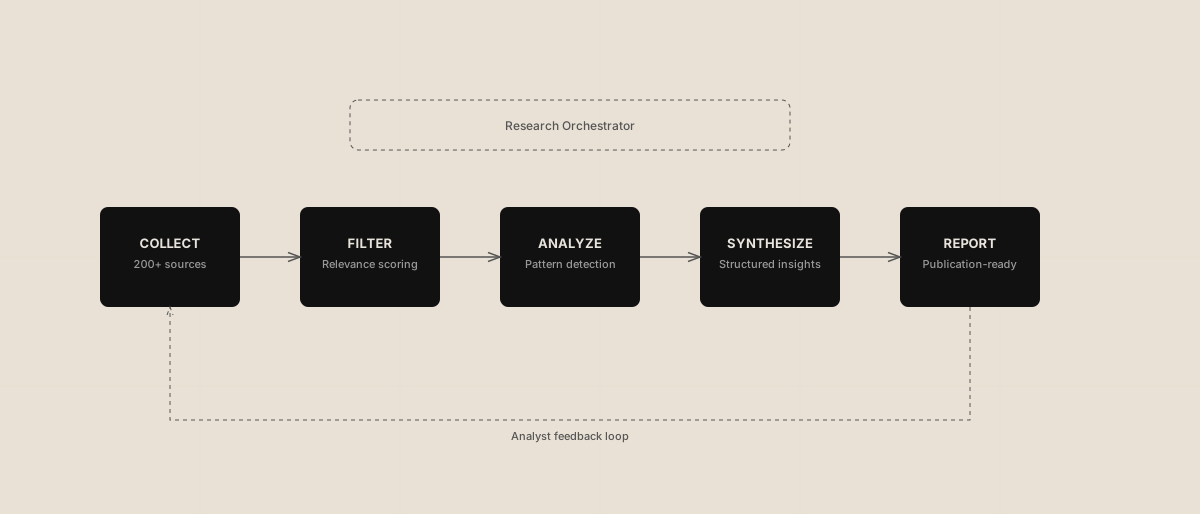
We designed five specialized agents coordinated by a central orchestrator to handle distinct phases of the research process:
- Collection Agent: Continuously ingests data from 200+ sources (APIs, web scraping, internal databases).
- Filter Agent: Uses embedding-based similarity search to isolate relevant signals and remove noise.
- Analysis Agent: Identifies patterns and cross-references new data against historical baselines.
- Synthesis Agent: Generates structured narratives with citations, mirroring the internal reporting style.
- Report Generator: Produces publication-ready documents including charts, confidence scores, and executive summaries.
Results
After 6 weeks of development and a supervised rollout, the system delivered immediate operational impact:
- 80% Workload Reduction: Analysts moved from 40 hours/week of manual collection to just 8 hours/week of strategic review.
- 3x Faster Delivery: Research cycles that previously took 3 weeks are now completed in 2–3 days.
- High Accuracy: The system achieved 94% accuracy within the first quarter through a built-in human-in-the-loop feedback mechanism.
- Increased Scalability: The system now processes over 50,000 sources weekly, generating 15–20 comprehensive reports autonomously.
- Strategic Re-alignment: Client satisfaction scores for the research department rose by 40% as analysts refocused on high-value strategic consulting.
"This didn't replace our analysts. It made them 5x more effective. They're doing the strategic work they were hired to do instead of copy-pasting from PDFs." — VP of Strategy, Client
