
The Shift Is Already Happening
Most companies think of AI as a tool — something you bolt onto existing processes to make them slightly faster. This is a fundamental misunderstanding of what's happening.
The companies that will define the next decade are those that rebuild their operations around AI from the ground up. They're not adding AI to their workflows. They're redesigning their workflows around AI.
This isn't a prediction. It's an observation. The shift is already underway, and the gap between AI-native companies and everyone else is widening every month.
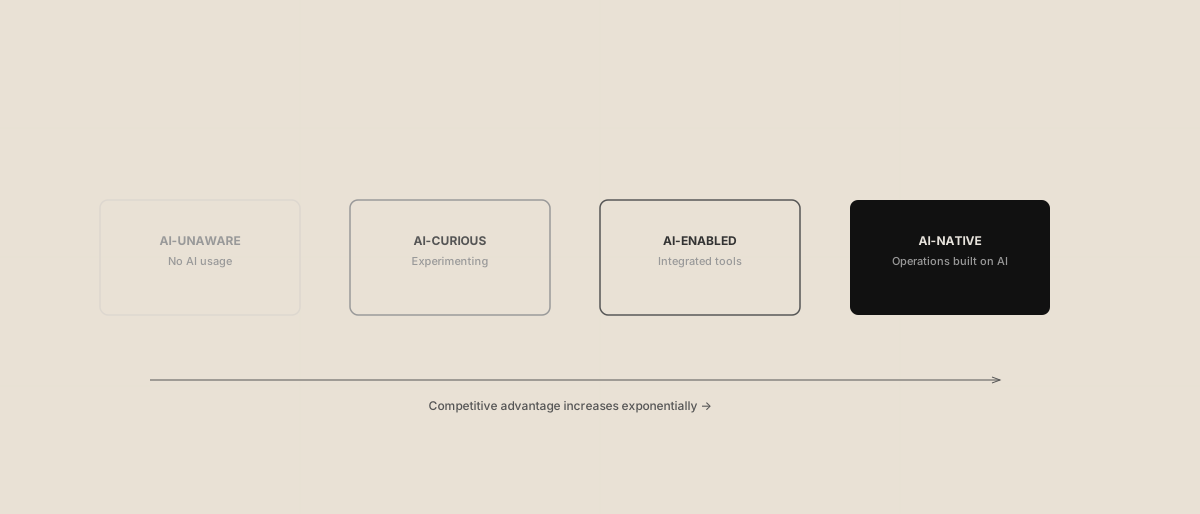
What AI-Native Actually Means
Being AI-native isn't about using ChatGPT or having a data science team. It means:
- Operations are designed for AI — Processes are structured so that AI systems can participate meaningfully, with clean data inputs and measurable outputs
- Data flows are intentional — Information moves through the organization in ways that AI can understand and act upon, not trapped in spreadsheets and email threads
- Human roles evolve — People focus on judgment, strategy, and creativity while AI handles execution, research, and pattern recognition
- Systems learn continuously — The organization gets smarter over time, automatically, because feedback loops are built into every process
The difference between "using AI" and "being AI-native" is the difference between having a smartphone and having a mobile-first business. One is a tool. The other is an operating model.
The Cost of Waiting
Every month a company delays becoming AI-native, the gap widens. Competitors who move now will have:
- More training data from their automated processes
- Better-tuned systems that have been refined by months of real-world feedback
- Deeper operational integration that compounds in value over time
- Efficiency gains that free up capital and talent for further innovation
This isn't a linear advantage. It's exponential. The same way early internet adopters had a compounding advantage over late movers, AI-native companies will have a structural advantage that becomes nearly impossible to close.
The question is no longer "should we use AI?" but "how fast can we make AI a core part of how we operate?"
The Three Layers of AI-Native Transformation
We've seen the most successful transitions follow a three-layer approach:
Layer 1: Process Automation — Start with the highest-volume, most repetitive tasks. These are the quick wins that free up capacity and build organizational confidence in AI.
Layer 2: Decision Intelligence — Move AI into decision-support roles. Not replacing human judgment, but augmenting it with better data, faster analysis, and pattern recognition at scale.
Layer 3: Strategic Operations — This is where AI becomes part of how the company thinks. Product decisions, market analysis, competitive intelligence, and strategic planning all become AI-augmented activities.
Where to Start
The path to becoming AI-native starts with understanding where AI can create the most leverage in your specific business. Not every process needs AI. But the ones that do will transform your organization.
Start with operations that are:
- High-volume and repetitive — The ROI is immediate and measurable
- Data-rich but insight-poor — You have the raw material but lack the capacity to analyze it
- Currently bottlenecked by human bandwidth — The constraint is people's time, not the complexity of the work
- Critical to your competitive advantage — Automating commodity tasks is table stakes; automating your core value chain is a moat
The companies that move first will set the standard. The rest will spend years trying to catch up.